
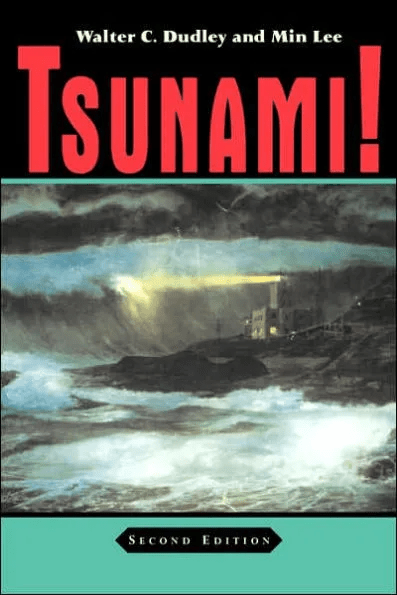
I picked this book up on Hawaii, at the Pacific Tsunami Museum in Hilo. Normal people pick up t-shirts as remembrances from vacations, or pins, or magnets. I pick up books. Packing strategically becomes important here, to allow adequate space.
After reading this book, our vacation in paradise took on a different aspect. “That’s where the 1946 tsunami took out a school full of kids, killing 25 people,” I’d say casually as we passed some peaceful park along the water. Or, “That park was added to keep people from building houses there again after a tsunami wiped out the neighborhood.”
A little knowledge is a dangerous thing. Even when I returned home, when water sloshed from one side of the pan I was watching to the other, “Seiche,” I pointed out. When a tsunami hits, the water sloshes from one side of the lake or bay or even the ocean to the other. That’s why, after the initial tsunami hits, you may want to stay at higher ground, because the water will slosh back and forth, and hit again and again. After the 1960 Chilean earthquake – which caused destructive tsunamis in Chile and Easter Island – Hilo braced itself and set off the tsunami warning. The first wave to hit Hilo was only 3 feet, which lulled many people into thinking it was a nothing-burger. The second wave was 9 feet. The third wave, which arrived at over 30 MPH chasing people in nightgowns down as the fled clutching deeds, banking records, and birth certificates, was 35 feet. Chaos ensued.
This book contains interesting facts, like that of the seiche. And it tells a lot of stories about tsunamis. On the mainland U.S., we tend to associate tsunamis with far-off places like Hawaii, Indonesia, and Japan or maybe, to a lesser extent, the West Coast. But they also happen in Alaska when, for example, part of a mountain and glacier slid into a bay. The resulting tsunami reached high up a mountain – over 1700 feet – on the opposite side of the bay, killing a few people on a boat and scaring a lot of other people.
Of course, there was also the terrible tsunami in Lisbon, Portugal in 1755. Many Americans don’t know about that because it happened a couple hundred years ago and on the other side of the ocean while we were distracted by local politics. The tsunami hit Lisbon the hardest but even across the Atlantic in the Barbados, the swells hit 12 feet.
We think of tsunamis as being caused by earthquakes or volcanos, but there have also been manmade tsunamis. One of the worst, which I will write about when I cover a book on this topic, occurred in Halifax during WWI when two ships collided, one secretly carrying dynamite. Boom. The resulting tsunami was more than 20 feet in some places.
My edition of this book1 and predates the recent devastating tsunamis in Japan and Indonesia. It describes the tsunami monitoring systems – which have evolved since this book was published – and the challenges with tsunami warning systems. Hawaii has invested a good amount of effort in removing houses from tsunami-prone zones and adding infrastructure to disperse tsunami waters, and educating their residents (and, to a lesser part, the tourists that flock there). With sea level rise, they may need to evolve again. But other areas with high tsunami potential along the West Coast, for example, don’t think so much about it and are at greater risk.
As humans, we don’t do a good enough job paying attention to the risks of nature. Wildfires burn down towns and the people vow to rebuild right in the same place. Floods wash away subdivisions and people proudly proclaim that nature won’t conquer them, no sirree, they will rebuild. People complain that they can’t get insurance for floods when they insist on living in flood zones. When I was in New Mexico recently, my sister and I visited a small “ghost” town – a fraction of the size that it was during the silver rush heyday, and now populated, the friendly, one-room, part-time librarian told us, by people over 60. (“There are a few 40-year olds but most of us are older.”) We walked the streets, referring to a walking tour pamphlet that described each house. “Washed away in the flood of 1910,” my sister read aloud. “Washed away in the flood of 1960.”2 The town, we realized when we consulted a map, was built on land that was encircled by a stream. Like most streams, creeks, and rivers in the southwest, it’s dry much of the time. But, based on what we read in the walking tour guide, it flooded every 10-20 years, taking out the town again and again. Afterwards, I suspect, some people vowed to rebuild and did. Others probably buried their dead, packed up and moved away. Others visited, and moved there when they retired or to practice writing or art or wildlife biology in a quiet, low-budget place, a place with a desert beauty. Rains, when they come in the desert, come suddenly and violently, often overflowing creeks, streams, and rivers far away from the storms themselves, taking people enjoying a sunny day by surprise. As they will again here, taking the elderly residents by surprise yet again, some day. Are they ready?
Are you?
This book is a great combination of science, history, and storytelling. The storytelling propels you through the book, making even the science easy to understand. And it contains interesting aspects of tsunamis that I didn’t suspect, like using sound and light to study them. The authors did a great job and I highly recommend this book. Especially if you live on the shore.
 Change+Management