
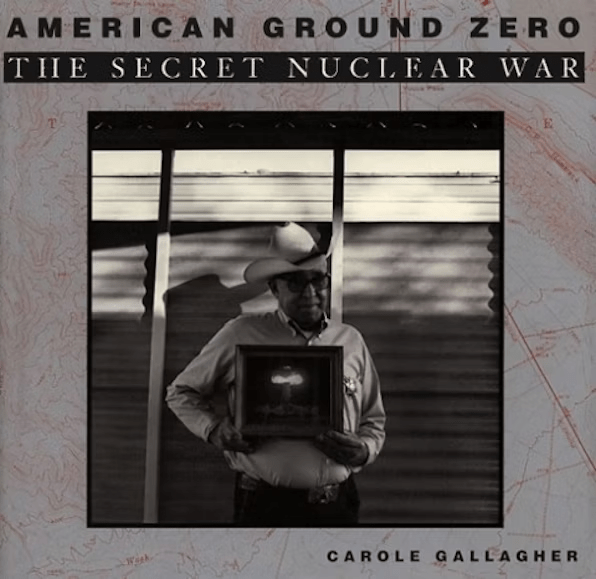
I don’t remember why I picked up this book originally. It may have been the photography – I’m a sucker for beautiful black and white photography. I remember that I started flipping through it, looking at the photography, and then I read the captions and then the little interviews that accompanied each photograph. Before I knew it, I was deep into this book. I ended by flipping back to the front and reading the introduction – pretty much the only piece of narrative in the whole thing. The images and stories in this book have stayed with me since I originally purchased it in the early 1990s, soon after it was published. Initially released by MIT, it was picked up and repackaged by Random House, and is now out of print, but you can find copies if you try.
The book is divided into four parts, each part focusing on a different segment of people and what they experienced during the 12 years that the U.S. was conducting above-ground nuclear testing in the rural southwest in the 50s and 60s. Three of the parts take their names from a quote from someone in that section:
- The Nevada Test Site Workers, Taking Risk As It Comes
- Atomic Veterans: “We were expendable”
- Downwind: “A low-use segment of the population”
- Contaminated Lives and Landscapes of the West: “A damn good place to dump used razor blades”
The format is simple: a photograph of someone who lived through these times, who experienced or heard family stories of the testing, sometimes holding another photo, a photo of a blast, or of their home or school after the blast, or someone they knew who was no longer with them. To the side, a short interview between Gallagher and the subject of the photograph. Often a half a page, maybe a page. Just telling their story. Sometimes photographs of the landscape, the homes, ghost towns, signs standing proud in the middle of nowhere, a store in the middle of nowhere.
Many of the people Gallagher photographed were proud that they “served their country” either directly by working on the tests, or indirectly as patriotic citizens who witnessed the tests and said nothing. They were proud, even while acknowledging the impact of the fallout on their families, their livestock, their pets, their friends, their communities. Some were reluctant: they let her take photographs but didn’t want to be interviewed. Americans of a certain generation, a certain Western culture are stoic: they endure without complaining; what’s the point?
It’s been around 30 years since I read this book and images stay with me. The testing “badges” they were given to wear, that would measure the fallout and change colors to warn them, that were defective or ignored. Children playing in the “snow” that fell on warm sunny days. A dog that, left outside, died. A pregnant sister who lost her baby. Enlisted men who were lined up to watch the explosions from a “safe” distance that sent them back to camp bleeding from eyes, nose, and mouth. Elementary schoolmates who got sick and then disappeared from school and church. A flock of sheep, too sick to be herded back to the homestead, too sick to move, just frozen standing in place until they fell over, dead, and were slaughtered and sold as meat.
It’s a beautiful book and terrifying. The first image, after the table of contents, isn’t a photograph, it’s a black-and-white map of the U.S. that looks as if someone had shied a rotten tomato at it at an angle, landing on Nevada, splatter stretching across the country, all the way to Florida, to Maine to Canada and the Gulf of Mexico, with a little back-splatter on the West Coast. It maps “areas of the continental United States crossed by more than one nuclear cloud from aboveground detonations.”
This – more than 3-Mile Island – was our Chernobyl. Literally, the period of 12 years when these tests were conducted created as much radiation as the Chernobyl power plant accident. And was covered up just as rigorously. Even today, people live and work on these lands and unsuspecting travelers drive through them, going from point A to point B, not realizing what they are driving through.
When I finished reading this book, I remember I sat and wrote and wrote, drafting out a novel about a child living there at the time, a child who didn’t recognize what was happening and put her own interpretation on it. I never finished the draft – it’s kicking around here somewhere in my someday pile. I often write when possessed by emotion and it’s hard to sustain that kind of emotion for the length of time needed to finish a novel. Perhaps I should rethink it as a trilogy of short stories.
This is not a hard book to read: you’re just flipping through a series of beautiful photographs. Where is that, you wonder or what’s going on there? Curious you read the caption, find yourself drawn into the interview. Then, oh sh*t, you think to yourself, really? And then you turn the page and start all over again. It’s hard to put this book down.
If I were writing true to form, I’d give you a little story here about the time we visited an Indian Chief at his home in Northern Arizona, a run down Victorian farm house surrounded by a radius of abandoned equipment, auto parts, and old mattresses – and then I’d link all this back to change somehow, the reluctance of people to accept change, completion bias, something. But this book stands on it’s own and I haven’t the heart, after revisiting it.
It’s out of print now, but you can still find copies kicking around and, if you Google her, you’ll find samples of Gallagher’s photos online. Include “photographer” in your search, since she shares a name with a blonde bombshell who did Westerns who is the first result that comes up.
It’s worth it.
 Change+Management