
I first encountered Shel Silverstein in high school, when one of my fellow drama freaks performed a dramatic interpretation of his poem, Dreadful. (“Someone ate the baby, I’m very sad to say. Someone ate the baby, So she won’t be out to play…”) It so perfectly captured the feelings that I wasn’t allowed to talk about at home*, that I became immediately hooked.
That is what Shel Silverstein does better than any other children’s poet I know: he captures the feelings that children have, that they can’t – or aren’t allowed to – put into words, and says them out loud. He often uses humor to make his words acceptable and even fun to talk about. From poems about sibling rivalry (One Sister for Sale) to exclusion (The Long-Haired Boy), to dentophobia (The Crocodile’s Toothache) to a child’s self-aggrandizement (Who) – just about any human feeling is captured in one of his poems.
And they’re so much fun to read aloud. Just listen to these first lines:
- “Sarah Cynthia Sylvia Stout just would not take the garbage out” – Don’t you want to know what happened next?
- “The gypsies are coming, the old people say, To buy little children and take them away.” – Sends shivers down my spine.
- “Joey Joey took a stone And knocked Down The Sun!” – Who hasn’t, as a young child, thrown stones higher and higher, aiming for the tops of trees and even the sun?
The words draw you in, make you care about the characters, and then, just when you’re least expecting, punch you with a twist, like the huge burp – written into the page – at the end of Dreadful.
At the same time, these poems stick in your head, like a song worm, refusing to leave. My main complaint about Silverstein’s work is they lurk in the crevasses of my hippocampus and pop out when triggered, declaring, “Oh what a day or what a day, my baby brother’s run away and now my tuba will not play” or “I cannot go to school today said little Peggy Ann McKay” at the slightest provocation, often startling colleagues or random strangers who are unfamiliar with Silverstein’s work. Please do not take it amiss if I come to your house for a bowl of lentil soup and recite aloud before my first spoonful, “A piece of sky broke off and fell through the crack in my ceiling right into my soup KERPLOP!”
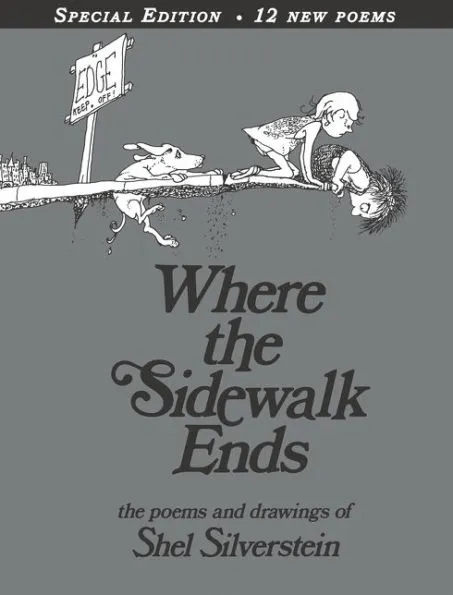
But when describing Silverstein’s work, you must also include the drawings. Sometimes the drawings enhance the poems, like in Enter This Deserted House or It’s Dark in Here. Some poem need the drawings to make sense, such as in The Loser or Jumping Rope. I like the cover illustration, the idea from Where the Sidewalk Ends, a place where you lose structure and find yourself in mud and rocks and eventually wildflowers – coupled with his illustration from The Edge of two children peering with fear and curiosity over the end of a sidewalk that is thin and unsupported by the earth, demonstrating how fragile civilization truly is.
He was a subversive guy, this Silverstein. And often banned by grown-ups. His work pokes fun at people who take themselves too seriously or want children to conform to ideas and rules, passing judgement on them. And yet he does not hesitate to poke at children themselves for watching too much TV or overeating or eating just one more peanut butter sandwich. He’s not afraid to say scary things out loud. There is no happy ending for the turtle in love with The Bagpipe that Wouldn’t Say No or for the child afraid to follow the piper in The One Who Stayed.
Shel Silverstein was someone who pivoted his career several times without ever losing the essence of himself. He started as a cartoonist and illustrator for Playboy. He wrote travelogues. He penned songs for people like Johnny Cash (A Boy Named Sue), Peter, Paul, and Mary (I’m Being Eaten by a Boa Constrictor, found in this book), Dr. Hook & the Medicine Show (The Cover of Rolling Stone), and others. His work has appeared on-stage, TV, and movies. He’s one of those guys, like Beck, who you don’t expect to crop up the movie credits and then – bang! – there he is!
And yet, through all this change, his voice is distinctively his.
Often when we want to change who we are, we start by casting out or covering up who we have been. Silverstein demonstrates another model: being more of who you are, leveraging your unique voice, and applying your skills in an ever-evolving variety of ways.
If you haven’t read Silverstein lately – or at all – dig up a copy of Where the Sidewalk Ends and read it aloud to a child or to your inner child. But beware, child, beware…
*Jealousy not cannibalism. Although, when you are a child, jealousy can eat you up, a sort of self-cannibalism.
 Change+Management