
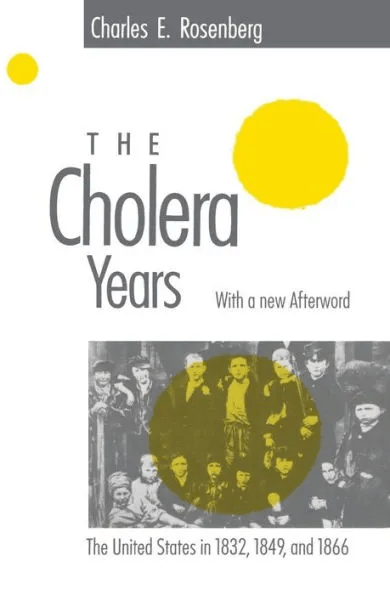
I picked up this fun little book at a library book sale many years ago. It describes three waves of cholera in the United States – 1832, 1849, and 1866 – with a focus on New York City’s experience.
Cholera, unlike the flu or Covid, is a bacterial infection, spread through food and water. It gets into your gut and is spread when you evacuate it. It contaminates the things you come into contact with or enters the water supply. You cannot vaccinate against it – you must defeat it by cleaning up the water supply and enforcing hand-washing. This is why it has, pretty much, died out in most places in the industrialized world and is mainly seen now in places that are unable to maintain a clean water supply separate from sewage contamination: refugee camps, war zones, and places where social order breaks down, such as whatever you call what is continually going on in Haiti.
When cholera hit New York in 1832, the city was unprepared. I almost typed “completely unprepared” but that wouldn’t be fair – they put as much effort into preparing as New York did in 2020. Believing that disease came from filthy water and streets – usually kept clean by pigs and dogs – they charged homeowners with cleaning up their sidewalks and cesspools. (And then, because of Tammany corruption, did nothing to follow up on this.) The state established quarantine restrictions, which were ignored by those who had places to go and couldn’t be bothered with such petty rules and by those who feared infection. The pious met to practice fasting, prayer, and humiliation. Those who could, left the city for the country; those who couldn’t escape, hid in their houses and stocked up on quack remedies. The streets emptied; the departure of the cities horses accomplished what the health department couldn’t: the streets were clean. At first, crime plummeted; then it surged. Businessmen and civic leaders complained that reporting cases was having a negative impact on the economy.
Although they focused on cleaning up streets, yards, and water, this had less to do with preventing bacterial infection, and more to do with the belief that disease was caused by poor moral choices. The is illustrated by the things that medical council advised people to avoid: overeating; consuming uncooked fruits and vegetables; indulging in alcohol; working in the heat of the afternoon; drinking “cold water when heated”; sleeping or sitting in “warm drafts;” and getting wet. (They also advised that sleeping and clothing warmly.) While some of these might incidentally protect you from bacterial infection – avoiding uncooked fruits and vegetables, drinking un-boiled water – it’s clear that the medical advice reflects the belief that disease was caused by lifestyle choices than by bacteria. Eventually, the medical association created hospitals where people with the disease could be quarantined – much to the ire of “the poor” who saw this as a violation of their rights – the epidemic ended, and the city reopened for business.
And very little changed. Sanitation wasn’t improved; the streets remained dirty. Doctors continued to wrestle with the medical causes of cholera*; and the average person pointed fingers at people who couldn’t afford to live in clean homes and neighborhoods and eat healthy food; and people who lived lives of vice – drinking, having sex outside marriage, not going to church, or worshipping in non-protestant ways. As cholera reappeared – first in Russia, then in the Southern US – the New York medical board tried to set up cholera hospitals but couldn’t get funding. When the first New York cases in 1849 emerged in a run down boarding house in the poverty-stricken neighborhood of Five Points** where an alcoholic laborer shared a basement with several women, most people assumed that lifestyle was to blame (of course he caught cholera – look how he lives! – someone like me could never catch cholera.).
As cholera spread, schools were turned into cholera hospitals – to the horror of the surrounding communities, who bemoaned the impact on the children’s education. As it spread further, the city emptied again, the sale of fresh fruits, vegetables, and fish were restricted, and the pious turned again to prayer. And yet, the streets remained filthy. (Rosenberg quotes a journalist who suggests that the only way to get the streets cleaned, would be to raise a fund to bribe the city council with.) By the end of August, the surge ended and cholera moved West to plague farming communities and the gold rush.
By the time cholera reappeared in 1866, New York had changed. Conditions in the poorest neighborhoods had gotten worse, with overcrowded tenements and endemic typhoid and tuberculosis. The state government established a true Board of Health, responsible for enforcing laws in NYC that would clean up streets and survey and cleanse neighborhoods. The medical understanding of cholera had changed, too, with Dr. John Snow’s famous removal of the London pump handle that demonstrated the link between infected water and the spread of the disease.*** This understanding was mixed: some doctors understood in principle, couldn’t accept in practice and still blamed the victims or assumed that it was contagious through the air; others assumed that all feces carried cholera, not realizing it was a bacterium in the feces that carried the disease.
When the disease emerged again, the new Board of Health took immediate action, evacuating other tenants to tent cities, disinfecting the premises and the possessions of the infected. The Board of Health had to fight judges appointed by corrupt politicians, who overruled their mandates. And had to overcame local politicians and their newspaper mouthpieces who claimed that the health regulations were imposed on the poor and the “working man” by the elite and encouraged antiimmigrant sentiments. Only when their efforts successfully managed the surge – and the streets began to smell better – did people reluctantly accept the new board.
This book is a fascinating exploration of how people’s attitudes toward disease have changed – and, based on recent events, not changed – over time. While I have summarized here my understanding of the overall contents of this book, there is far more here to read, and far more subtle analysis of the attitudes of the religious, medical, and health authorities during these three outbreaks. I highly recommend it.
As a change management professional, I was often responsible for influencing behavior of large and diverse groups of people. During Covid, I watched the attempts to encourage people to wear masks, avoid crowds, adjust to home schooling and WFH, and get vaccinated – and wondered how I would have approached this challenge in a smaller, controlled experiment, for example in an isolated community without the outside influences of 24-hour news, talk radio, and social media. But then I read about the reaction to epidemics in rural communities of the middle ages and the early U.S. and reflect on the circularity of history, and wonder how successful I could have been.
*Keep in mind the ignorance of the medical profession at the time. Until the late 19th century, one of the leading causes of death for women in childbirth was being attended by a doctor (as opposed to a midwife). However, even the few male doctors who realized the difference that washing their hands and putting on clean clothing between patients were laughed at and dismissed by most other doctors for almost 100 years. Those silly old wives’ tales about washing your hands! This is why, in books from the 1600’s through the 1800’s, it’s not unusual to read of children who are orphans or motherless.
**Where the movie, Gangs of New York, took place.
***Somewhere on my shelves I have a book about this, as well. But they’ve gotten so disorganized, I have no idea where it is.
 Change+Management