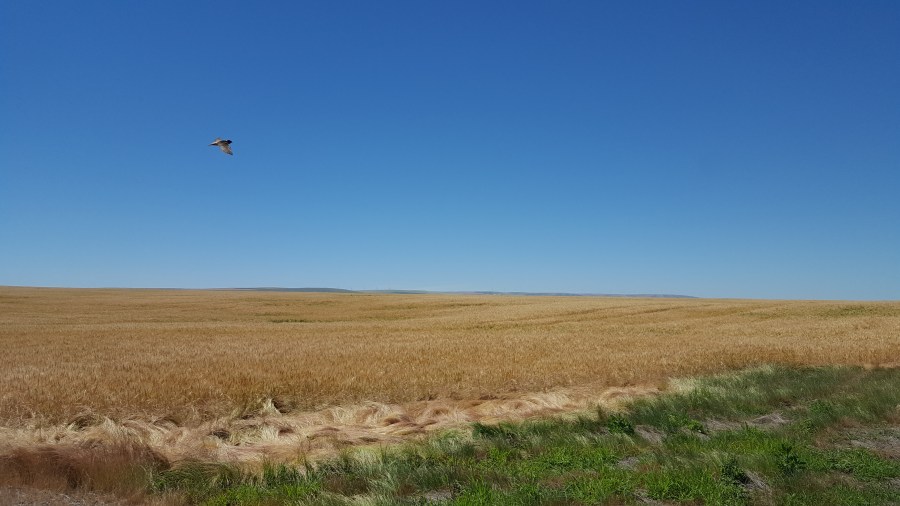
This is, I think, my second favorite book in the Little House series, next to The Long Winter. It feels like a season of fallow for the Ingalls family, a chance to rest and recuperate before diving back into their struggle to survive. This is also Laura’s last burst of childhood, before she is expected to take on adult responsibilities. Even the cover illustration captures this feeling: Laura, alone, astride a galloping pony, skirt flapping in the wind, with nothing but the blue sky above and green grass stretching as far as the eye can see, no sunbonnet, her hair flying loose.
The book does not start with such freedom. Plum Creek has not been good to the Ingalls family. In the previous book, Pa, excited by the early promise of his first harvest, had mortgaged the land for a plow, and for milled lumber and glass windows and a Franklyn stove for their home, only to lose that crop and the next three in a grasshopper plague. Pa has had to take work away from home just to pay for food. And, at the start of Silver Lake, the family is recovering from scarlet fever, which means doctor’s bills on top of everything else. When a strange lady in a buggy drives up the road to their house, Laura and Ma are more daunted than welcoming: the house is a mess, Laura is exhausted, and everyone is depressed because Mary’s sight has faded away. At a time and a place when guests were always welcome, they don’t have a thing to offer.
But then it turns out that the strange woman is a relative, someone the girls remember from The Big Woods, and she has an offer Pa can’t refuse: settle up with Plum Creek and come West to work on the railroad. Laura and Pa are excited – the road whispers to them – and they prep the wagon for Pa to go West with Laura’s aunt and get started. Pa is able to sell the farm to pay off his debts (there is some question in real life, whether he paid them off or they just slipped away in the night), but Laura has one more sadness before she goes: faithful dog, Jack, who has followed the wagon across three books, and who brought in help when they had malaria in Kansas, and whom Laura – busy caring for her sick family and keeping the house going – has been neglecting, dies before Pa sets out. His death like a bell tolling for their covered wagon days.
But happier times are ahead for Laura and family. Pa, able to secure a job as bookkeeper and paymaster for the crews laying the Western railroad, sends money back and the family packs a handful of bags, and buys train tickets West. There’s the excitement of taking a train for the first time, of traveling faster across the prairies than they ever could have in their wagon, of dining out for the first time. Then Laura connects with her cousin, who runs wild on the family ponies, singing songs that Ma does not approve of. Laura gets to go with Pa to watch them men building the railroad, fascinated by the smooth motion of the engineering teams. All this bustle is capped off when the railroad closes up for the season, pays off the men, and moves on.
The railroad leaves behind a snug house with a full pantry, and needs someone to stay and protect it and their equipment over the winter, because their surveyors are not thrilled with the idea of a prairie winter. Pa agrees to caretake and the family moves in. This is, by far, the nicest house they’ve lived in, to date. It’s warm; it’s well-stocked with food; and the family settles in for, what feels like, a winter of fallow. Their only neighbor is a friend of Pa’s and his young wife – just a few years older than Mary – who make merry companions during this winter of joy. They help the wife decorate the one-room house nearby, where she and her husband have settled in for the winter. They pop pop-corn and have merry feasts. Laura and Carrie slide along the moonlight path across Silver Lake. Pa plays the fiddle and they all sing.
Silver Lake is such a relief after the horrors and stress of Plum Creek. Laura runs wild with her cousin, then experiences a quieter joy with the young Mrs. Boast. Pa finds the perfect piece of property for their next farm. And the whole family enjoys a quiet winter, the safety of a warm home, and the security of a well-stocked larder – and a well-needed break before the following The Long Winter.
With the spring thaw, things pick up speed again. Men heading West appear at their door, seeking shelter, including, to Ma’s joy, a pastor they had known earlier. He is the one that gives Mary and Ma hope again, by sharing the news of a college for the blind, where Mary can continue her education. Following him are a slew of men flooding in to stake their claims. Pa and Mr. Boast race East to file their own claim and Ma and Mrs. Boast rent out space on the living room floor, amassing what seems like an almost unbelievable amount of money: $15.25.
Then it’s back into the whirlwind, for the town is springing up, Pa tosses up a building in the heart it all, and the family moves in. Then it’s off to their claim, where they quickly erect a one-room shanty to live in. And the book ends with the family sitting cozily in their tiny home, surrounded by the smell of violets and moonlight, like a sigh of relief.
We are all so busy, our lives feel so frenetic, and we’ve all suffered so much over the last four years, sometimes it feels we could all use a quiet season of fallow. Quiet, without outside intrusion, surrounded by safety and comfort. A time for one last time where we can live as a child, sliding on the ice in the moonlight, riding ponies across the prairie, barefoot, our hair loose in the wind, singing songs our mothers disapprove of.
Anhedonia, begone!
We all need a break, time off between chaotic interludes of aging parents, demanding jobs with unrealistic expectations, overscheduled children, simmering climate change, ridiculous gun violence, and threats to democracy. Sometimes I dream of abandoning all my digital ties, my high-maintenance furniture, heels and mascara (well, maybe not the mascara but certainly the eye-liner), and set off in my own covered wagon to follow the Ingalls path West like that blogger did a few years ago (I’ve got her book here somewhere and will cover it at some point).
But then, what would I do with my books?
So, instead, I read By the Shores of Silver Lake.
And dream…
 Change+Management